For the past few years, my fiancé and I have tried to learn Pirkei Avot (Ethics of Our Fathers) every week. Recently, we read Chapter 5, Mishnah 6, which describes the ten things God created at twilight on the eve of the Sabbath. One of the ten is called Shamir in Hebrew, which translates to English as Shamir. So, what is the Shamir?

The Talmud in Sota 48b explains that the Shamir was about as big as a barleycorn, was as old as creation, and was so strong that “nothing hard could withstand it.” It was wrapped in tufts of wool and kept in a lead tube filled with barley bran (presumably because it would eat through anything sturdier). And what was its purpose? Sota 48b says that the names of the twelve tribes had to be engraved on the stones of the High Priest’s breastplate, but the stones had to stay whole. So, the craftsmen wrote the letters in ink, showed the stones to the Shamir, and then the stones split along the ink lines on their own.
But that still doesn’t say what the Shamir was. The Talmud calls it a beriyah (a “creature” or “created thing”), but medieval commentators give it a more concrete identity. Rashi calls it a kind of worm in his comments on Ezekiel 3:9 and Pesachim 54a. Rambam, in his commentary on our Mishnah, describes a small creeping creature that splits large stones as it passes over them. Jastrow’s Talmudic dictionary sums it up in one phrase: “a worm that cuts stones with its glance,” since the Shamir was shown the stones.
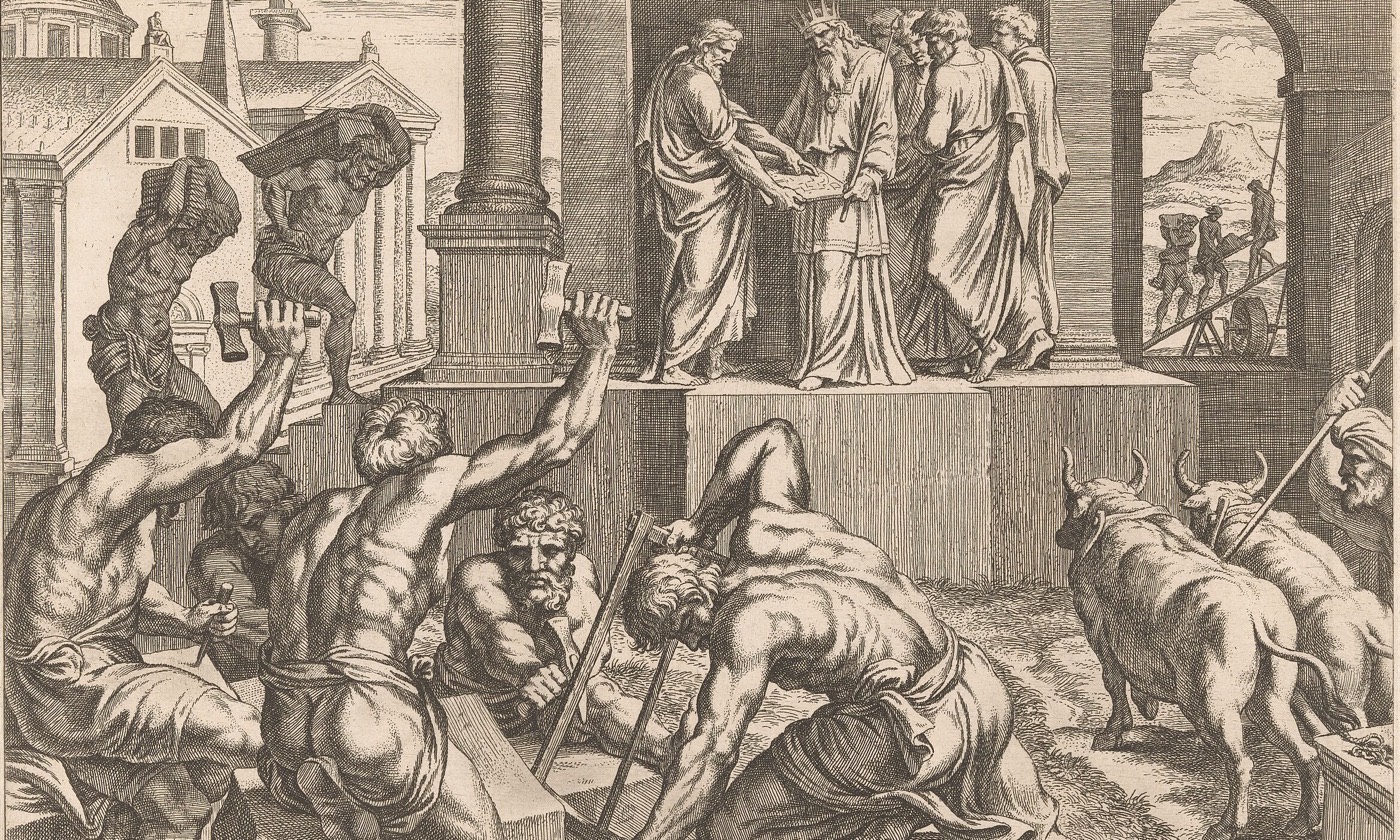
The Shamir is said to have played a critical role in the building of the First Temple. The Torah says twice (Exodus 20:22 and Deuteronomy 27:5) that an altar must not be built with iron, so when describing the First Temple’s construction in I Kings 6:7, the text notes it was made of stone finished at the quarry, with no hammer, axe, or any iron tool heard in the house while it was built. In Sota 48b, Rabbi Nehemiah takes the simple reading: tools cut the stones off-site. However, Rabbi Yehuda reads the verse to mean no iron touched the stones at all. If that’s true, you have an engineering problem: How do you shape blocks of limestone without metal? The Shamir.
The Talmud in Gittin 68 tells the (fantastical) story of how Solomon got the Shamir to build the Temple. I will give you a summarized version:
Solomon asks the sages how to cut stone without iron. They tell him about the Shamir, which Moses used to engrave the breastplate, but nobody knows where it is. So Solomon interrogates a pair of demons, who say: we don’t know, but Ashmedai, king of the demons, might. Ashmedai has a routine: Every day he goes up from his mountain to study (Torah?) in the heavenly academy, comes down to study in the earthly one, checks the seal on the pit of water on his mountain, and then drinks water.
Solomon sends his general, Benaiah, with a chain and a ring, both engraved with God’s name, plus wool and wine. When Benaiah reaches the mountain, he drains the pit of water, plugs the hole with wool, and refills it with wine. When Ashmedai returns, he drinks the wine and passes out.
Chained up and brought before Solomon, Ashmedai says the Shamir isn’t his. He says it belongs to the Prince of the Sea, who lends it under oath to one creature: the tarnegola bara (“wild rooster”), which Rashi identifies as the dukhifat, the hoopoe. The tarnegola bara uses the Shamir to split mountains, drop seeds in the cracks, and make things grow.
So, Benaiah finds the tarnegola bara’s nest and covers the chicks with glass. The tarnegola bara returns, can’t reach its young, and gets the Shamir to break through the glass. Benaiah startles the tarnegola bara, who drops the Shamir, and Benaiah takes it. The story ends on a sad note: the tarnegola bara, having broken its oath, kills itself.
As you can see, it’s a wild story. Conveniently, the Shamir disappears from existence after the Temple is destroyed. If you are like me, you may also wonder how much of the story is true, how much was influenced by surrounding cultures, and, if it isn’t true, how the stones were cut for the Temple.
The first part of the story worth a deeper dive is the Demon King Ashmedai. Ashmedai’s earliest surviving appearance in Jewish literature is in the Book of Tobit. There, a woman named Sarah in the city of Ecbatana (in Persia) has been married seven times, and each time the demon Asmodeus has killed the groom on the wedding night. Notice the story is set in Persia, and the name Asmodeus / Ashmedai sounds a lot like Aēšma, the demon of wrath in Zoroastrianism (the religion of the Persian Empire that ruled the Jews for two centuries). In fact, take Aēšma and add the Avestan word for demon, daēva, and you get Aēšma-daēva (which sounds very close to Asmodeus). So, perhaps the demon king was borrowed from Persia.
The second part of the tale worth a deeper dive is the bird. A similar story appears in surrounding cultures and evolves over time. An earlier version comes from Pliny the Elder in the first century CE, followed by Aelian’s account roughly a century and a half later, in which the bird is a hoopoe. The primary difference is that in these earlier tales, the bird uses an “herb” to pry its way into its blocked nest, while in the Talmud, it uses a Shamir, a magical creature that cuts glass. The Rabbis may have known of the “herb” version as well, because in Vayikra Rabbah 22:4, Rabbi Shimon ben Halafta watches a bird (a hoopoe again) use an “herb” to get rid of a nail blocking its nest (a very similar story).
Moreover, the Rabbis in the Talmud were not the only ones to adapt this Mediterranean tale. Around 1173, the Christian scholar Peter Comestor retold it in Latin with a worm called Tamir whose blood cracks the glass. As an interesting aside, Comestor was from Troyes, the same French town where Rashi lived and taught until he died in 1105. Rashi is the one who calls the Shamir a worm, and his students were still teaching there when Comestor was growing up. So, Comestor may have heard the story about it being a worm from them. Also, Islamic tradition kept the story and even the name: there, the stone is called Samur (the Arabic form of Shamir), and the bird uses it to shatter the crystal over its nest. Some think the Arabic version was borrowed from Jewish tradition. My guess is it crossed over before medieval commentators settled on a worm, back when the Shamir could still be a stone (explained more below).
And that brings us to what I believe is the most satisfying answer to what the Shamir actually was: a tool. The word Shamir appears a few times in the Bible and hints at a different way to understand it. In Jeremiah 17:1, Judah’s sin is written with an iron pen and engraved with a Shamir point, and Ezekiel 3:9 describes the prophet’s forehead as Shamir (harder than flint). So in Jeremiah, the Shamir is an engraving tool, just like in Sota 48b.
But Shamir has an even older meaning in Isaiah: a thorn. Klein’s dictionary suggests the word first meant a prickle used as an engraving point, and then the hard stone such points were made of. Ancient craftsmen used a hard stone to engrave: emery (a dark, gritty rock made mostly of corundum, the second-hardest natural mineral after diamond). In fact, the Metropolitan Museum notes that archaeological and experimental evidence shows craftsmen used emery across the ancient Mediterranean and Near East. The Greek island of Naxos was the famous source.
Consider the Greek word for emery powder: smiris. Doesn’t it sound a lot like Shamir? Klein’s dictionary defines the biblical Shamir as emery, and says the Greek word smiris likely comes from the Hebrew word Shamir. Klein traces the word’s evolution: Greek smiris, later Greek smeri, Italian smeriglio, French émeri, and finally English emery. The idea that the legend grew out of emery goes back at least to the German scholar Paulus Cassel, who argued in 1856 that corundum powder was reimagined as a tiny creature and eventually a worm. Think about how emery works, and maybe it makes sense why people would make the jump from ‘rock’ to ‘creature’: A pinch of dark grit, each grain smaller than a barleycorn, that eats through the hardest gem without a blade.
References
Texts
- Pirkei Avot 5:6. sefaria.org/Pirkei_Avot.5.6
- Babylonian Talmud, Sota 48b. sefaria.org/Sotah.48b
- Babylonian Talmud, Gittin 68a–b. sefaria.org/Gittin.68a
- Exodus 20:22; Deuteronomy 27:5; I Kings 6:7; Isaiah 5:6; Jeremiah 17:1; Ezekiel 3:9. Exodus, Deuteronomy, I Kings, Isaiah, Jeremiah, Ezekiel
- Vayikra Rabbah 22:4. sefaria.org/Vayikra_Rabbah.22.4
- Rashi on Ezekiel 3:9, Pesachim 54a, Gittin 68b, and I Kings 6:7. Ezekiel, Pesachim, Gittin, I Kings
- Rambam, Commentary on the Mishnah, Avot 5:6. sefaria.org/Rambam_on_Pirkei_Avot.5.6
- Book of Tobit, the story of Sarah of Ecbatana. Posen Library. posenlibrary.com/node/10433
Other sources
- Aelian. On the Characteristics of Animals, 3.26 (the hoopoe and the herb). attalus.org/translate/animals3.html
- Baring-Gould, S. (1876). Schamir. In Curious Myths of the Middle Ages. wikisource.org
- Cassel, P. (1856). Ueber Schamir. Erfurt.
- Comestor, P. (c. 1173). Historia Scholastica, on the book of Kings.
- Jastrow, M. A Dictionary of the Targumim, the Talmud Babli and Yerushalmi, and the Midrashic Literature, s.v. שָׁמִיר. sefaria.org
- Klein, E. A Comprehensive Etymological Dictionary of the Hebrew Language for Readers of English, s.v. שָׁמִיר. sefaria.org
- The Metropolitan Museum of Art. Hidden secrets of ancient Egyptian technology. Perspectives. metmuseum.org
- Pliny the Elder. Natural History, 10.20 (the woodpecker). Trans. J. Bostock and H. T. Riley (1855). perseus.tufts.edu