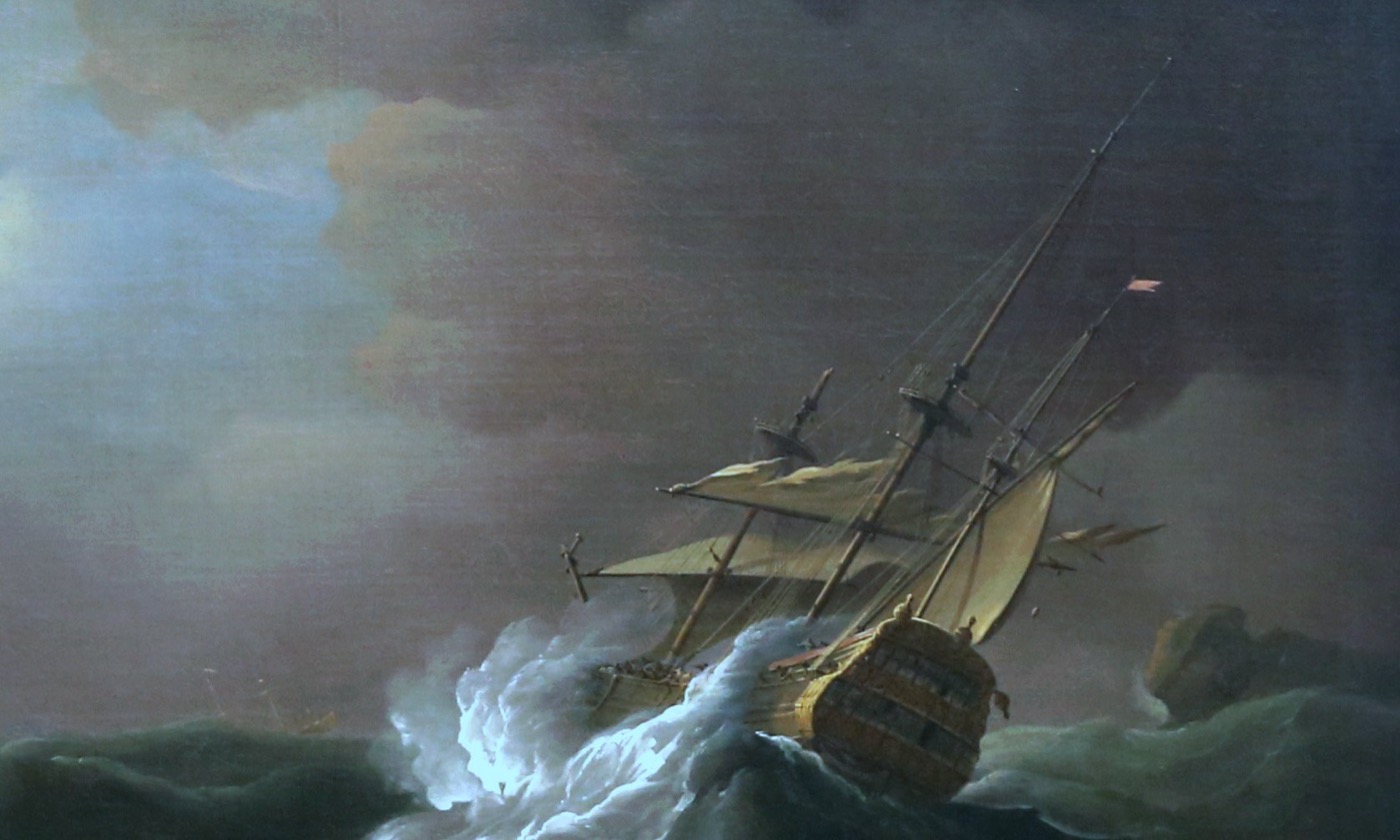
About a year ago at this point, I read a book called “The Wager” by David Grann. This book tells the true story of a shipwreck and mutiny in the year 1740, using journal entries from some of the crew. To me, some of the most fascinating parts were when Grann explains that many words/phrases we use today originated with sailors. This interest brought me down a rabbit hole to find as many of these stories as I could, and now I get to share some with you.
“Under the Weather”
Most of us have likely used this term to describe feeling ill, and that is the correct definition, but haven’t you ever wondered what feeling sick has to do with the weather? When sailors were seasick on boats, they moved to a lower-level deck to protect them from harsh conditions like wind or rain. The original full phrase was “under the weather bow,” because the bow (front) of the ship usually experienced the worst in a storm.
“A Loose Cannon”
This phrase describes a wildly unpredictable person who could cause real damage. Originally, it had little to do with a person. On warships, cannons weighed thousands of pounds and were carefully strapped in place using rope. However, if those ropes snapped during a storm or battle, the cannon became a literal ‘loose cannon’ that would swing violently across the deck, becoming a deadly and uncontrollable hazard.
“A Slush Fund”
On long voyages, the ship’s cook would boil heavily salted meat for the crew, and the fat that rose to the top of the boiling water (known as “slush”) was skimmed off and stored in barrels. When the ship finally reached port, the cook would sell this hardened fat to local candlemakers, and with that cash, he would have a “slush fund.” This was then used to buy small luxuries for the crew.
“To the Bitter End”
On a ship, the “bitts” are the heavy wooden/iron posts fastened into the deck where anchor cables are tied off. The last section of the anchor rope, closest to the bitts, was called the “bitter end.” If the water was extremely deep or the ship was in a violent storm, the crew had to let out the anchor rope until there was no slack left, so they reached “the bitter end.”
“I’m Overwhelmed”
Long before it described an emotional state, it was a sailor’s worst physical nightmare. The word comes from the Middle English whelven, meaning to turn upside down. To be “overwhelmed” literally meant that your ship had been caught in a catastrophic storm, completely submerged by a towering wave, and capsized into the deep. Now, we use it when we’re stressed.
“I Can’t Fathom It”
You may not know this, but a “fathom” is a standard nautical unit of measurement equal to six feet, traditionally used to measure ocean depth. Sailors would drop a weighted rope over the ship’s side to gauge how much safe water was beneath their hull. If the entire rope ran out before the weight hit the floor, the water was immeasurably deep, so the crew literally couldn’t fathom it.
“Filibuster”
We hear this word constantly in politics to describe a prolonged, rambling speech designed to delay a legislative vote. This word comes from the Dutch vrijbuiter (freebooter) and the Spanish filibustero, used to describe ruthless pirates, privateers, and mercenaries in the 17th to 19th centuries. Just as those groups would hijack ships and hold the crew hostage, a politician conducting a filibuster is, in essence, hijacking the legislative floor.
“Turn a Blind Eye”
British naval hero Admiral Horatio Nelson lost sight in his right eye in a previous battle. During the Battle of Copenhagen in 1801, his commanding officer raised a flag signal ordering him to retreat. Not wanting to abandon the fight, Nelson dramatically raised his telescope to his blind eye and declared, “I really do not see the signal.” He pressed the attack and ultimately won the battle.