Hi! Welcome to my 0th blog post! These will be rather informal: mostly just a way for me to organize some of my thoughts and any ideas I find interesting. Forgive me for any grammar/spelling mistakes; I hope not to use AI at all in the actual writing of these posts.
As a computer scientist, naturally my blog posts will be zero-indexed. For issue #0, I thought it would be fun to speak about zero!
This past summer, I would drive over to Barnes & Noble, pick out a book, and spend hours reading it from cover to cover. One book I read is called “Zero: The Biography of a Dangerous Idea” by Charles Seife. To us, this number is commonplace, but it was originally quite controversial. Surprisingly, there’s a large gap between the concept of ‘nothing’ and assigning this ‘nothingness’ a symbol we use in math. And this ‘nothingness’ in math can actually have jarring real-world consequences. For instance, on September 21, 1997, the USS Yorktown was shut down for nearly three hours after a crew member entered a zero into a database field triggering a ‘divide-by-zero’.
The reason why zero was ‘dangerous’ is because of how it challenged ideas in religion and philosophy. In ancient Greece, people used math to understand abstract ideas and the cosmos, and they didn’t see room for ‘nothing’ there. The Pythagoreans (yes, the same root as that theorem you learned in school) acted less like a math club and more like a religious cult. They believed the universe was built on clean ratios, rationality, and geometry, and since they couldn’t imagine a shape with ‘zero sides’, the number couldn’t exist. This leads to the Pythagorean Irony: if you have heard of a2 + b2 = c2, it’s funny to observe that if you have a square with the simple side lengths of 1, the diagonal is √2 – an irrational number (but don't tell Pythagoras that...) Beyond this, Aristotle argued that “nature abhors a vacuum” (horror vacui), viewing zero and infinity as two sides of the same dangerous coin. This fear solidified in Western thought over time.
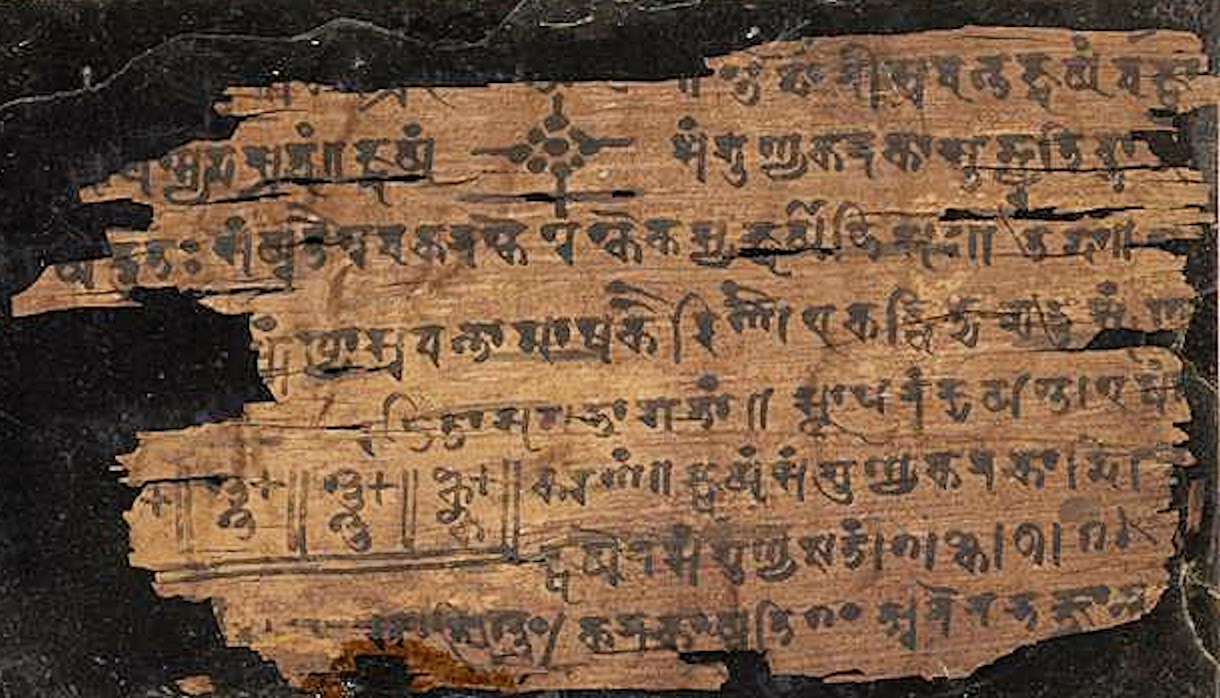
However, in regions where the people did not fear ‘nothingness’, the number zero – and therefore math – flourished. In India, Hinduism and Buddhism embraced the infinite and the void (Śūnyatā) because they viewed emptiness as the source of creation. So, in the 7th century, mathematician Brahmagupta stopped treating zero as a placeholder, and made it a real number with its own rules. Eventually, Arab and Persion scholars studying Indian mathematical texts would popularize this number and go on to create algebra. In fact, the names used today reflect this cultural movement: The Arabic word for zero, sifr (meaning empty), was later translated into Latin as zephirum, which eventually became the English word “zero”.